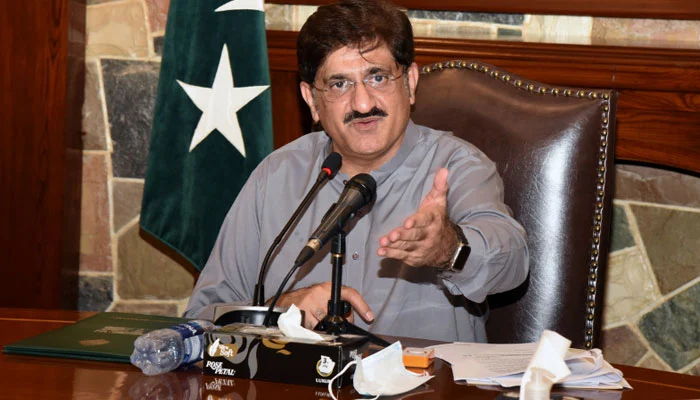
Sindh Chief Minister Syed Murad Ali Shah Wednesday approved the construction of the Korangi Crossing Bridge and Hub Canal rehabilitation projects, directing the local government department to complete both projects within a year.
The chief minister issued these directives while presiding over a meeting to review different projects planned to be launched in the city at the CM House.
“The existing causeway submerges during monsoon seasons, therefore, the people of Korangi and Malir face serious problems,” he said, adding that with the construction of a bridge, 28% of the population of Korangi and Malir would be facilitated.
The CM directed the local government to complete it within a year and start its work on a top-priority basis. “I would provide you funds, just go into tendering,” he said.
CM Murad also greenlighted the Jam Sadiq Bridge project and directed the Planning and Development Department to prepare a scheme to overhaul it. “The launching of the Hub Canal Project would be financed by the government to be completed within a year,” he added.
The Election Commission of Pakistan on Friday disqualified as many as 25 Punjab MPAs for violating Article 63-A of the constitution.
The provincial legislators were disqualified for changing their loyalties by voting against the party line. The PTI MPAs voted for Pakistan Muslim League-Nawaz’s Hamza Shehbaz Sharif for Punjab Chief Ministership. The ECP has also suspended the Punjab Assembly’s membership of the dissident MPAs.
The decision announced today was reserved on May 17.
Punjab Assembly Speaker Pervaiz Elahi, earlier, sent the reference to the ECP for lifetime disqualification of 26 MPAs of PTI. These members deviated from the party line and voted in favour of Hamza Shehbaz Sharif of PML-N in the election of the chief minister of Punjab.
ISLAMABAD: President Dr Arif Alvi on Thursday expressed confidence that Pakistan would gain an influence in the world by making its economy stable and maintaining a strong defensive line.
“Through its integrity, economic stability, strong defence and national unity, Pakistan will emerge as a country with an impact in the world,” he said in his address to the military officers and soldiers, at the Parade Ground in Islamabad.
The president joined the troops at the Bara Khana – a traditional joint feast for the officers and soldiers of all ranks, held at the culmination of the arrangements for the Pakistan Day parade.
He lauded the finest arrangements made by the administrators of the parade on March 23, which was also witnessed by foreign delegates including the foreign ministers of the Islamic countries.
President Alvi stressed a constant vigilance to counter nefarious designs of the enemy and called for effectively addressing the emerging challenges, particularly cyber warfare.
Dr Alvi paid tribute to the country’s armed forces for defending the frontiers and for their immense contribution to the sovereignty of the homeland.
“Your immortal sacrifices for the country will never be forgotten,” he told the troops.
He said Pakistan Army was the only military in the world that fought the war against terrorism and extremism in a “proper and effective manner”.
He mentioned that the army always provided relentless services to the nation in times of natural disasters, be it earthquakes or floods.
“We are proud of our army and believe that a strong army is vital for a strong nation,” he said.
He said the Pakistani nation had emerged resilient and steadfast after passing through several difficult times in its history.
He urged the nation to have pride in its own values, which were imbibed with Islamic culture and ethics, and not to let the criticism of the world distract them from their goals.
The president recalled that in response to India’s nuclear test in 1974, Pakistan strengthened its defence line by achieving atomic deterrence in a short span of seven years.
In the wake of the global refugee phenomenon, he pointed out the hypocrisy of the ‘champions of the world human rights’ that let the migrants drown in the Mediterranean Sea.
Contrary to this, he said, Pakistan hosted around four million refugees from Afghanistan for over 40 years.
“This spirit of compassion and humanity makes the Pakistani nation stand tall amongst the comity of nations,” he said.
Earlier, President Alvi distributed shields to administrators of the Pakistan Day parade on making excellent arrangements.
National Assembly (NA) Speaker Asad Qaiser has summoned the session of the lower house of parliament on March 25, a notification issued by the NA Secretariat today said.
This will be the 41st session of the National Assembly, which will convene at 11am.
NA speaker has rejected the opposition’s request of summoning the session on March 21.
According to the notification, the session has been summoned after the joint opposition made the requisition for it under Article 54 of the constitution along with the submission of the no-confidence motion against the prime minister on March 8.
Article 54 of the constitution reads that once a session of the lower house been requisitioned with signatures of at least 25 per cent of the members on it, the speaker has a maximum of two weeks to summon a session.
In his address to the nation, Prime Minister (PM) Imran Khan announced a surprising relief and shared that Rs10 per litre in the petrol price and Rs5 per unit in power tariff for low and middle-income electricity consumers and all commercial consumers have been slashed to combat inflation.
PM Imran Khan also announced that the petrol price and power tariff would remain unchanged until the next budget.
Along with this, he said 26,000 scholarships, costing Rs38 billion will be given to students.
He said the inflation rate in different tenures of the Pakistan Peoples Party (PPP) and Pakistan Muslim League (PML-N) stayed in the double-digits.
He compared that the inflation rate is around eight per cent in the PTI’s tenure. “I accept there is inflation, but it is due to the global factors.”
He said the country was in a rough condition economically when they assumed power, adding the Covid-19 pandemic then hit the world and brought inflation.
The premier said Pakistan imports ghee, pulses, and other food items which resulted in a price hike.
Citing examples of the US, Canada, United Kingdom (UK), and Turkey, PM Imran said the developed countries also suffered a spike in inflation due to pandemic-induced disruption of the supply chain.
Speaking on foreign policy, he said they have vowed to develop an independent foreign policy to benefit the country after coming into government.
He cited Pakistan joining the war on terror started by the United States (US) as an example of failed foreign policy.
PM Imran said the US launched more than 400 drone attacks in the last 10 years of two democratic governments, compared to only 10 in the military regime of Pervez Musharraf.
He urged the nation to never vote for the politicians who have accounts in foreign countries as they could not devise an independent foreign policy due to conflict of interest.
He told that the visits to Russia and China remained successful and the nation would soon hear ‘good news’.
Talking about the Prevention of Electronic Crimes Act (PECA) law, PM Imran said they have amended the law made in PML-N’s last tenure to curb filth on social media.
He lamented that even the premier of the country is not being even spared, and fake news is being against him and his wife.
PM Imran shared he filed a petition against a journalist who had claimed that his wife had left home, but there has been no progress in the last three years.
He said Jang Group accused Shaukat Khanum Memorial Hospital (SKMH) of redirecting charity towards Pakistan Tehreek-e-Insaf (PTI).
The premier said being a sportsman, he has faced criticism all his life but PECA law has become important for the country to control the filth.
He rejected the notion that it was against ‘freedom of expression’ and said the mafias are blackmailing in the name of ‘freedom of expression’. PM Imran claimed the genuine journalists would be happy with the law against fake news.
Further, he cited different international recognitions to rebuff the rhetoric that the incumbent government is inept.
A Sessions Court on Friday sought record from the Federal Investigation Agency (FIA) on a post-arrest bail petition of a PML-N activist arrested allegedly for “running a malicious campaign against Prime Minister Imran Khan, his wife Bushra Bibi and the army on social media.”
Advocate Farhad Ali Shah filed a bail petition on behalf of the PML-N activist, Sabir Hashmi, saying the petitioner had been falsely implicated in the case at the behest of the ruling party – Pakistan Tehreek-i-Insaf.
He said the case against the petitioner was totally false, frivolous, and baseless and had been registered with mala fide intention and ulterior motives. He said the petitioner had no nexus with the alleged crime.
The counsel contended that the case required further inquiry with regard to the guilt of the petitioner, therefore, he was entitled to bail as a right.
Additional District & Sessions Judge Yasin Shaheen issued a notice to the FIA and summoned the record of the case on Feb 19 (today).
The FIA cybercrime wing had booked Hashmi under sections 20, 21 (d) and 24 of the Prevention of Electronic Crime Act (PECA).
The board of Punjab Small Industries Corporation (PSIC) has approved to increase the grant for daughter’s marriage up to Rs100,000 and funeral grant from Rs10,000 to Rs100,000 for the employees.
Minister for Commerce and Industry Mian Aslam Iqbal chaired a meeting of PSIC board on Thursday, where the board declared the establishment of a surgical city in Sialkot and a new industrial estate in Gujrat “Time-Bound Projects”. Both these projects will be completed within a period of 18 months.
The board approved in principle the establishment of Small Industrial Estates in Kamalia and Hafizabad.
During the meeting, the board also approved extending the period of construction in small industrial estate sunder 2 till February 2024.
The meeting also decided to conduct a performance audit of the cluster development project and also reviewed the lease policy instead of selling plots in industrial estates.
Iqbal during the meeting said that the PSIC should play a proactive role in enhancing economic activities.
ISLAMABAD: A specially convened meeting of the 57 member states of the OIC on Sunday vowed to play a leading role in delivery of humanitarian assistance to the people of war-torn Afghanistan and unanimously agreed on establishing a Humanitarian Trust Fund, launch a Food Security Programme and engage with the World Health Organization for securing vaccines and medical supplies.
The meeting of the 17th Extraordinary Session of the OIC Council of Foreign Ministers held on the initiative of Saudi Arabia and hosted by Pakistan was attended by around 70 delegates from the member states, international aid agencies and special representatives.
The unanimously adopted Joint resolution brings a glimmer of hope for the 22.8 million people – more than half the population of Afghanistan – who face acute food shortage; while 3.2 million children and 700,000 pregnant and lactating women are at a risk of acute malnutrition.
The document adopted after day-long deliberations at the Parliament building also expressed solidarity with the Afghans and reiterated the commitment of the OIC Member States to help bring peace, security, stability, and development to Afghanistan.
The extraordinary meeting was convened as the UN’s estimates warned that 60% of Afghanistan’s 38 million people face “crisis levels of hunger” and that the situation was getting worse every day. The OIC also expressed deep alarm at the deteriorating humanitarian crisis in Afghanistan.
Prime Minister Imran Khan earlier in his keynote address warned; “Unless action is taken immediately, Afghanistan is heading for chaos.”
He said “chaos suits no one” and urged the world to understand the gravity of situation and reach out to the Afghan people who were facing starvation.
The Council of Foreign Ministers also took into account the fact that the United Nations High Commission for Refugees, has pointed that 665,000 people have been newly displaced within Afghanistan between January and September 2021 – in addition to the 2.9 million people already internally displaced by conflict in Afghanistan.
Expressing deep concern over the breakdown of Afghanistan’s health system, disease outbreaks and severe malnutrition, in particular in the face of COVID-19 pandemic, the OIC decided to establish a Humanitarian Trust Fund, under the aegis of the Islamic Development Bank; which would serve as a vehicle to channel humanitarian assistance to Afghanistan including in partnership with other international actors.
The Council of Foreign Ministers decided that the OIC General Secretariat, together with the Islamic Development Bank and Humanitarian Trust Fund, shall commence discussions with the UN system organizations to device a road map for mobilizing actions in relevant fora to unlock the financial and banking channels to resume liquidity and flow of financial and humanitarian assistance. It would also devise a mechanism for the disbursement of urgent and sustained humanitarian assistance to the people of Afghanistan.
In this regard, the Islamic Development Bank was urged to expeditiously operationalize the Humanitarian Trust Fund by the first quarter of 2022. Meanwhile, the meeting called on the OIC Member States, the Islamic Financial Institutions, donors and other international partners to announce pledges to the Humanitarian Trust Fund for Afghanistan as well as to provide humanitarian assistance to Afghanistan.
The meeting expressed deep alarm at the worsening economic situation in Afghanistan, which it pointed was further compounded by the continued freeze of overseas Afghan assets as well as other international assistance, exacerbating the urgent cash-flow problems, including payment of remuneration to public officials, and hindering the provision of essential public and social services to the people of Afghanistan.
The moot, which was also addressed by Foreign Ministers of Saudi Arabia, Turkey, Niger, Jordan, OIC Secretary-General, UN’s Emergency Relief Coordinator, President Islamic Development Bank, warned that an economic meltdown in Afghanistan would lead to a mass exodus of refugees, promote extremism, terrorism, and instability, with dire consequences for regional and international peace and stability.
The Council of Foreign Ministers commended Pakistan and Iran’s hospitality, in hosting millions of Afghan refugees for over four decades. It also pointed that millions of Afghan refugees are already residing in the neighbouring countries and beyond due to the protracted conflict and ensuing economic and social challenges spanning over 40 years.
The meeting stressed upon the need to support Afghanistan in addressing poverty, creating employment opportunities, and provision of essential services to its citizens, in particular food, clean water, quality education, health services.
The OIC while deciding to launch an Afghanistan Food Security Programme, requested the Islamic Organization for Food Security (IOFS) to undertake necessary work in this regard using the capacity of the Organization’s Food Security Reserves, when necessary.
It also urged the OIC Member States, international donors, the UN Funds and Programmes and other international actors to generously contribute to the Afghanistan Food Security Programme.
The meeting reiterated its call on the OIC Secretary-General to engage with donor financial institutions to provide necessary humanitarian and economic assistance to Afghanistan as well as Afghan refugees in neighbouring countries.
An urgent appeal was also made to OIC member States, the international community including the UN system, international organizations, and international financial institutions to continue to provide all possible and necessary recovery, reconstruction, development, financial, educational, technical and material assistance for Afghanistan as policy tools to promote realization and enjoyment of fundamental rights and freedoms by all Afghan citizens.
ISLAMABAD, Dec 19 (APP): The Muslim world leaders attending the extraordinary session of OIC countries’ foreign ministers, Sunday called for an immediate and unified action to avert the looming humanitarian crisis in Afghanistan which otherwise could impact world peace.
Addressing the opening session of the 17th extraordinary Session of the Organisation of Islamic Cooperation’s (OIC) Council of Foreign Ministers to discuss the humanitarian situation in Afghanistan, the leaders were unanimous to call for the OIC’s role to protect the brotherly country from an economic collapse.
In his address, Saudi Foreign Minister Prince Faisal bin Farhan Al Saud said that the economic difficulties could trigger a humanitarian crisis and lead to further instability, impacting impact regional and international peace.
He said the people of Afghanistan have suffered for too long and had faced years of instability.
The Saudi FM said that the OIC meeting expressed solidarity with the Afghans and drew the world’s attention towards the need for immediate action to put an end to the deteriorating situation.
He also urged OIC member states to play a part in providing the Afghans with the necessary support and to prevent an economic collapse in the country.
He told the gathering that Saudi Arabia had extended aid of one billion Saud Riyals and had recently airlifted food supplies on the directives of King Salman bin Abdulaziz. He also condemned terrorist actions targeting minorities in Afghanistan.
Pakistan has decided to also allow the use of Afghan trucks for the transportation of wheat from Wagah border to Torkham, said a Foreign Office statement issued on Friday.
The decision has been taken with a view to further facilitate Pakistan’s decision to allow transportation of 50,000 MT of wheat and life-saving medicines from India to Afghanistan via Wagah border on an exceptional basis for humanitarian purposes.
“This demonstrates the commitment and seriousness of the Government of Pakistan to facilitate the proposed humanitarian assistance,” said the FO statement.
The decision was conveyed to the Charge d’ Affaires of India today at the Ministry of Foreign Affairs. The Indian government was also urged to proceed quickly to take necessary steps to expeditiously undertake the delivery of the humanitarian assistance to Afghanistan.

 Musawar Ali